China has become a major sourcing destination for disposable protective masks. Its manufacturers serve hospitals, distributors, retailers, and industrial buyers worldwide. Yet choosing a reliable supplier requires more than comparing prices. A professional Non-Woven Mask manufacturer should demonstrate stable production, documented quality controls, and clear communication.
This guide examines leading Chinese suppliers through practical buyer concerns. These include raw material consistency, meltblown filtration layers, ultrasonic ear-loop welding, packaging accuracy, and production capacity. Factory experience matters when large orders require dependable delivery. A capable supplier should also provide product specifications, test reports, sample approval, and traceable batch information. Small details matter. A loose ear loop can damage customer confidence.
Compliance must be checked for the destination market. Buyers should confirm applicable standards, labeling rules, and required documentation before placing an order. Certifications should be verified independently where possible. A polished website proves little. Factory audits, video inspections, and physical samples offer stronger evidence. Still, no evaluation is perfect. Supplier conditions may change, and test results may not represent every production batch. This guide therefore encourages careful comparison, direct questions, and written agreements covering quality, lead time, packaging, and after-sales support. The strongest manufacturers are not always the cheapest. They are usually the suppliers that explain limitations clearly and respond consistently when problems appear.
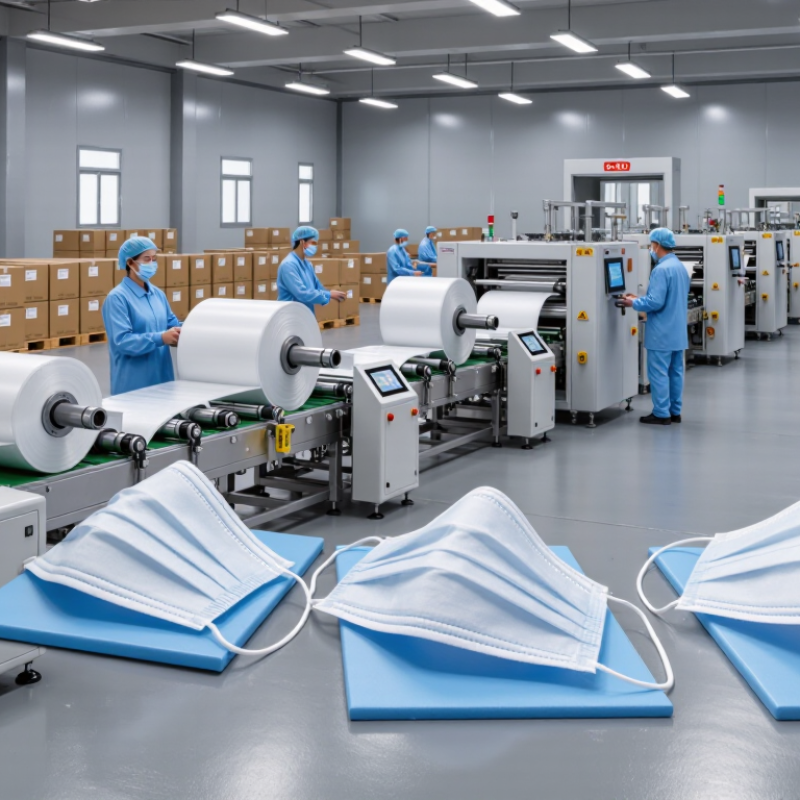
China’s nonwoven mask industry combines large-scale converting lines with mature spunbond and meltblown supply chains. China Customs reported 224.2 billion masks exported in 2020, showing exceptional emergency capacity. That figure reflects a crisis peak, not normal demand. It should not guide every purchasing decision.
Global buyers now examine performance, documentation, and supply reliability. The World Health Organization estimated global demand at 89 million medical masks monthly during the early pandemic. Current orders are more selective, but hospitals, workplaces, and emergency stockpiles still require consistent filtration.
Relevant standards include GB/T 38880 in China, EN 14683 in Europe, and ASTM F2100 in the United States. Testing should confirm bacterial filtration, particle filtration, breathing resistance, splash resistance, and skin safety.
Capacity claims can sound impressive. Audited production records matter more.
Tips: Request recent laboratory reports, production photographs, and batch traceability. Check whether the report matches the exact mask model. Ask about meltblown storage and incoming-material inspection. A low price may hide unstable filtration or weak elastic attachment. Buyers should also review export packaging, pallet protection, and sampling procedures before signing large contracts. Smithers’ face-mask market research indicates demand is moving toward quality-focused, application-specific products. That shift is practical, though forecasts remain uncertain. Forecasts can age badly.
China’s non-woven mask manufacturers increasingly serve global buyers with 95%+ filtration capabilities. Many use a three-layer structure: spunbond outer fabric, melt-blown filter media, and a soft inner layer. The melt-blown layer performs most filtration work. Fit still matters.
Reliable factories verify filtration through documented laboratory testing. Buyers should request test methods, particle size, airflow rate, and production dates. A “95%+” claim means little without these details. Serious suppliers also track raw materials by batch, inspect nose wires, and check ear-loop strength during production.
In practical audits, examine clean production rooms, storage conditions, and sample consistency. Hold several masks against light. Uneven texture can signal poor material control, though appearance alone proves nothing.
Check whether the nose strip bends smoothly and stays in place after movement. Small details affect leakage.
Manufacturing is not perfect. A strong test result from one batch cannot guarantee every shipment. Humidity, melt-blown quality, and machine settings may change performance. Buyers should arrange pre-shipment inspections and independent testing when the order is substantial.
Clear specifications reduce disputes. Written records matter.
Choose suppliers that explain limitations instead of promising universal protection. 马会
China Top Non Woven Mask Manufacturers for Global Buyers
When comparing non woven mask manufacturers, study BFE, PFE, and pressure drop together. BFE measures bacterial filtration at a defined particle size and flow rate. PFE evaluates smaller particles and often reveals differences in filter quality. Pressure drop shows how hard it feels to breathe through the material. A high filtration result is not automatically better if breathing resistance becomes uncomfortable. Ask for complete laboratory reports, including test conditions, sample layers, airflow, and moisture status. Numbers without testing details can mislead even experienced buyers.
Tips: Request samples from the same production batch. Compare filtration, breathability, fit, and edge sealing. Keep the test method consistent.
During supplier evaluations, inspect the meltblown layer, spunbond texture, ultrasonic seams, and nose-strip placement. These details affect real use. Check whether the factory controls raw materials, machine settings, and batch records. Independent testing adds confidence, especially when results appear unusually high. A practical mistake is comparing a dry laboratory sample with a humid-use sample. Performance may change. I have also found that softer fabric can increase comfort while slightly raising pressure drop. That trade-off deserves discussion, not quick rejection. Global buyers should value repeatability, clear documentation, and honest limits over impressive figures alone.
| Mask Category | Typical Nonwoven Construction | BFE Requirement or Benchmark | PFE Requirement or Benchmark | Pressure-Drop Requirement or Benchmark | Applicable Test Method or Standard | Typical Buyer Use | Key Comparison Point |
|---|---|---|---|---|---|---|---|
| General Disposable 3-Ply Mask | Spunbond outer layer, melt-blown filtration layer, spunbond inner layer | Usually specified at 95% or higher | Often specified at 95% or higher at the selected test particle size; confirm because PFE is not universally required for general-use masks | Common commercial target: approximately 20–40 Pa/cm², depending on material weight and airflow | Buyer-defined specification; testing may reference ASTM F2100, EN 14683, or an equivalent laboratory method | General hygiene, visitor protection, low-risk environments | Request the exact particle size, airflow rate, sample conditioning, and laboratory report. BFE and PFE values are not interchangeable. |
| Medical Face Mask, Type I | Normally 3 or 4 layers with a melt-blown filtration layer and fluid-resistant outer layer | At least 95% | Not the primary classification requirement under EN 14683; particle filtration data may be supplied as additional information | Differential pressure less than 40 Pa/cm² | EN 14683:2019+A1:2019 | Medical and clinical environments where fluid splash resistance is not the primary requirement | Confirm BFE, differential pressure, microbial cleanliness, and biocompatibility as separate criteria. |
| Medical Face Mask, Type II | 3 or 4 layers with a higher-efficiency melt-blown media and protective outer layer | At least 98% | Not the primary classification requirement under EN 14683 | Differential pressure less than 40 Pa/cm² | EN 14683:2019+A1:2019 | Healthcare settings and procedures without a high expectation of liquid exposure | A high BFE result does not automatically prove high PFE performance; ask for both when particle filtration matters. |
| Medical Face Mask, Type IIR | Type II construction with an added fluid-resistant outer layer | At least 98% | Not the primary classification requirement under EN 14683 | Differential pressure less than 60 Pa/cm² | EN 14683:2019+A1:2019 | Clinical procedures where protection against potentially contaminated liquid splashes is required | Also requires synthetic blood penetration testing; filtration efficiency alone does not demonstrate splash resistance. |
| ASTM Level 1 Procedure Mask | Typically 3 layers: spunbond, melt-blown, and spunbond; may include a fluid-resistant outer surface | At least 95% | At least 95% | Delta P less than 5 mm H₂O/cm² | ASTM F2100; BFE and PFE are commonly tested at 0.1 µm with an airflow of 28.3 L/min | Low-risk procedures and general healthcare use | Compare results only when the test particle size, challenge aerosol, airflow, and reporting units are identical. |
| ASTM Level 2 Procedure Mask | Multi-layer nonwoven structure with improved fluid resistance and filtration media | At least 98% | At least 98% | Delta P less than 6 mm H₂O/cm² | ASTM F2100; synthetic blood penetration resistance is also evaluated | Moderate-risk procedures with possible fluid exposure | Check whether the quoted filtration result is a certified ASTM result or an internal screening result. |
| ASTM Level 3 Procedure Mask | Multi-layer nonwoven structure with the highest fluid-resistance classification within ASTM F2100 procedure masks | At least 98% | At least 98% | Delta P less than 6 mm H₂O/cm² | ASTM F2100; synthetic blood penetration tested at 160 mm Hg | High-risk procedures involving substantial fluid or aerosol exposure | Pressure-drop performance should be reviewed together with fluid resistance because added barrier layers can affect breathability. |
| Disposable Medical Mask under YY 0469 | Usually 3 layers with a melt-blown middle layer and a fluid-resistant outer layer | At least 95% | At least 30% | Pressure differential not greater than 60 Pa/cm² | YY 0469-2011; synthetic blood penetration requirement is at least 16.0 kPa | Medical use in markets requiring the Chinese medical surgical mask specification | Do not compare the PFE value directly with ASTM or EN results without checking particle size and test conditions. |
| Disposable Medical Mask under YY/T 0969 | Commonly 3 layers with melt-blown filtration media | At least 95% | PFE is not the principal mandatory classification value; request it separately if needed | Pressure differential not greater than 49 Pa/cm² | YY/T 0969-2013 | Routine medical and everyday healthcare use without surgical fluid protection claims | Verify whether the product is registered and tested as a medical device rather than sold only as a general protective mask. |
| FFP2 Nonwoven Respirator | Multi-layer molded or folded respirator using electrostatically charged filtration media and a close-fitting seal | Not normally reported as BFE for respirator classification | At least 94% filtration of test aerosols under EN 149 conditions | Maximum inhalation resistance typically 240 Pa at 95 L/min; maximum exhalation resistance typically 300 Pa | EN 149:2001+A1:2009 | Respiratory protection against particles in occupational environments | Fit, inward leakage, breathing resistance, and total classification are more important than a standalone BFE result. |
| N95 Filtering Facepiece Respirator | Multi-layer electrostatic nonwoven filter with a tight-fitting facepiece design | Not normally reported as BFE for NIOSH classification | At least 95% filtration at the NIOSH test challenge, including a 0.3 µm mass-median aerodynamic diameter particle | Maximum inhalation resistance 35 mm H₂O; maximum exhalation resistance 25 mm H₂O with an exhalation valve or 35 mm H₂O without a valve | NIOSH 42 CFR Part 84 | Certified occupational respiratory protection | A surgical mask BFE claim cannot be used to claim N95 equivalence; certification, fit, and inward-leakage requirements are different. |
| High-Breathability Buyer Specification | Low-basis-weight spunbond and melt-blown layers optimized for airflow while retaining filtration performance | Target commonly set at 95–98% or higher, depending on the intended standard | Target commonly set at 95–98% or higher when particle filtration is required | Buyer target often below 40 Pa/cm² for loose-fitting medical masks; the accepted limit must follow the selected standard | Must be linked to one declared standard and one validated test protocol | Long-duration wear, hot climates, and high-throughput healthcare use | Do not accept “high breathability” as a test result. Require numerical differential-pressure data with the test airflow and area stated. |
| Buyer note: BFE measures bacterial aerosol filtration under a specified test setup, PFE measures particulate filtration under a different specified setup, and pressure drop measures airflow resistance. Values should only be compared when the standard, particle size, airflow rate, sample area, conditioning, and reporting units are equivalent. | |||||||
China’s leading non woven mask manufacturers serve global buyers through documented quality systems and controlled production. ISO 13485 certification shows that a manufacturer operates a medical-device quality management system. Buyers should check the certificate scope, validity, audit body, and covered products. A certificate alone is not enough.
CE compliance depends on the mask’s intended use and applicable European requirements. Ask for the Declaration of Conformity, technical documentation, and relevant test reports. FDA requirements also need careful review. FDA registration or listing does not automatically mean product approval. The manufacturer should provide traceable records, labeling details, and evidence supporting the intended market. Small gaps matter.
GB 2626 applies to respiratory protective products in China, with performance requirements such as filtration and breathing resistance. Request reports from qualified laboratories, production batch records, and sample comparisons. During factory audits, inspect clean areas, melt-blown material storage, packaging seals, and ear-loop strength testing. These details reveal daily discipline.
Experienced suppliers can explain differences between medical masks and protective respirators without vague promises. They should also control raw-material lots and retain samples for investigation. Documentation may look complete while production practice varies. That is an uncomfortable but important risk. Global buyers should verify claims independently, because even a well-managed factory can make occasional mistakes.
The global nonwoven fabric market was valued at about USD 53.5 billion in 2022, according to Grand View Research. Its projected 7.6% CAGR signals steady demand for disposable protective products. Buyers should not treat market growth as a quality guarantee. A factory audit still matters.
MOQ varies by material, mask structure, and packaging. Standard three-layer masks may begin at 10,000 pieces, while private-label orders often require higher volumes. Ask for a written breakdown of fabric, ear loops, printing, and cartons. Lead times commonly range from 15 to 30 working days after artwork approval. Custom packaging may add another week. Delays happen. Plan buffer time.
Private labeling requires controlled artwork, batch records, and traceable carton marks. Request pre-production samples before mass manufacturing. Quality control should cover filtration performance, breathing resistance, ear-loop strength, seal condition, and visual defects. ISO 2859-1 sampling methods can support consistent inspection decisions. For export markets, confirm applicable requirements, such as EN 14683 or ASTM F2100, with an independent laboratory. Smithers’ nonwovens industry analysis also highlights continued demand for higher-performance filtration materials. Yet laboratory results can vary by test method. This is where buyers need careful review, not attractive claims. Random carton inspections, retained samples, and shipment photographs create useful evidence.
Copyright © 2021 United Orthopedic Corporation All Rights Reserved.
Necessary cookies are absolutely essential for the website to function properly. This category only includes cookies that ensures basic functionalities and security features of the website. These cookies do not store any personal information.
Any cookies that may not be particularly necessary for the website to function and is used specifically to collect user personal data via analytics, ads, other embedded contents are termed as non-necessary cookies. It is mandatory to procure user consent prior to running these cookies on your website.